
Safeguarding India’s Storytelling Legacy And Shaping Its Future!
With a legacy spanning more than five decades, Amar Chitra Katha has introduced generations of children to India’s vast cultural, mythological, and contemporary narrative worlds. In this insightful conversation, she reflects on the evolving role of Indian comics in preserving tradition, embracing inclusivity, adapting to the digital age, and nurturing a new generation of readers in a rapidly changing cultural landscape. Here, Gayathri Chandrasekaran, Editor-in-Chief, Tinkle, shares more.

India is a land of myriad stories. With its rich heritage of multiple indigenous civilizations, cultures and languages, even if each one of us wrote down a story a day, we wouldn’t be able to document all the stories in a lifetime. “Our mythology is vast with infinite characters and infinite versions. We are an inclusive people who have embraced multiple foreign cultures, thus allowing for pluralism in storytelling. Anant Pai, our founder, envisioned Amar Chitra Katha as a chronicler of these stories giving children a route to their roots. Over a period of 55+ plus years, we have brought out more than 600 titles chronicling the epics, our history, our folklore, towering personalities who have shaped our nation and more. But the work is far from done. There are still so many stories to be told,” shares , Gayathri Chandrasekaran, Editor-in-Chief, Tinkle.
On India’s storytelling heritage…
 “India has varied storytelling traditions. Our rich and diverse folklore has been passed down generations through village elders, bards and travelling performers. We are so geographically and culturally diverse that the lore, language and dialect change every few hundred kilometres. This heritage is invaluable and must be preserved. The traditional formats need to be preserved too. These include formal (classical) song and dance formats like Bharatnatyam, Kathak, Mohiniattam, etc., informal (folk) formats such as yakshagaana, theyyam, katha, villupaatu, and art-based formats like Kalamkari, Patachitra, Warli, Putal Nach, etc. Stories aren’t restricted to these grand performances but are an intrinsic part of our daily life and rituals. Why is something cooked a certain way? Why is a certain colour worn during a festival? Why does the Sun rise in the morning and set at dusk? Rather than a ‘dull’ scientific explanation, our ancestors decided that we would remember stuff better if they concocted stories. These stories have become a part of our collective identity. What do we want to bequeath to future generations? The fact that there is space for everyone and everything, that multiple realities can co-exist without feeling threatened by the other. They must inherit not just a land, but a living, breathing culture that embodies India’s diversity and spirit.,” she shares.
On Tinkle…
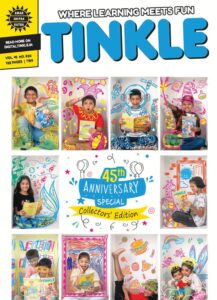
“In Tinkle, our monthly magazine, we have homegrown heroes and superheroes; Indian IPs such as Shambu and Suppandi that are household names today. Tinkle focuses on contemporary Indian fiction, that interestingly draws from the readers. We get a few hundred letters from children each month with feedback and ideas for stories, which we then refine and use. In that sense, Tinkle can be seen as a mirror reflecting the thoughts of children today. Both the brands have undergone tremendous evolution over the years,” she shares.
On changing trends…
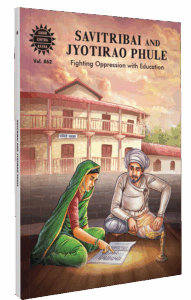 “Our editorial policy places great emphasis on inclusion and kindness. In keeping with this ethos, we endeavour to bring out titles such as Tribal Leaders of the Freedom Struggle, Savitribai and Jyotirao Phule and stories of women pathbreakers from diverse fields ranging from science to social reform.Even in our retellings of mythology, you will see the change. For example, in a recent book titled Celestial Beings, there is a scene where Mayasura asks Indra for Hema’s (an apsara) hand in marriage. Instead of saying, Indra agreed to the match, we have chosen to say, “With Hema’s consent, the marriage ceremony was performed.” It’s a small thing, but the impact is big,’ she adds..
“Art is the hero of comics and there is a sea of change in the art styles. We consciously make an effort to break stereotypes of all kinds. Be it gender roles, skin tones, body image or the depiction of what ‘good’ and ‘evil’ should look like. These changes lend themselves more easily to Tinkle. We write stories with characters who are differently abled (ranging from a sensory or physical impairment to autoimmune disorders such as vitiligo), are neurodivergent and gender fluid. We introduced a non-binary character in one of our popular and long-running series, The Defective Detectives. Our newest toons are a group of women homemakers of all ages who fight goons. Shikari Shambu, ostensibly inspired by the likes of Jim Corbett during the times when man- eating tigers had to be hunted, is now a conservationist, albeit a reluctant one, who ‘shoots’ with his camera.
 He is a spokesperson for everything related to nature, ecology and protection of the Earth. Suppandi, our most beloved character, who was viewed as a simpleton/ village bumpkin who did domestic jobs is now an urban dweller who shares an apartment with a friend, earns his living and is never deterred from trying a new job. He is gentle, has a different approach to life, makes people laugh and has found a place in almost every Indian’s heart,” adds Gayathri.
“In a nutshell, we continue to tell Indian stories in keeping with the changing sensibilities and needs of our readers. India has a strong oral tradition of storytelling. Stories have been traditionally passed down from grandparents to grandchildren. In today’s nuclear family set up, who is telling the stories? That is where publishers come in. It’s more important than ever to continue creating and publishing stories,” she adds.
Challenges faced…
“We have faced challenges a plenty. Both Amar Chitra Katha and Tinkle were big hits in the 80s. But liberalisation brought with it cable television and suddenly, screen was vying with books and reading for a child’s attention. Publishing took a hit. Then came the internet which opened a Pandora’s box of possibilities that further encroached on a child’s time,” she shares.
“At the same time, the whole world unanimously agrees that there is quite nothing like reading. Apart from the well-chronicled benefits such as improved focus, imagination, vocabulary, critical thinking and empathy, reading forces us to slow down and stay still in our fast-paced life. There are tangible, physical changes that happen in the brain when we read. New pathways and neural networks are formed by the simple act of reading. We recommend reading very passionately in our interactions with teachers and parents during our school visits,” adds Gayathri as a matter of fact.
Embracing change…
“The Covid 19 lockdown was a very challenging time for Amar Chitra Katha. We had to close our offices almost overnight. Printing of physical copies came to a halt. The teams continued to create content. Luckily, Amar Chitra Katha and Tinkle had their own reading apps, even though they were still in the early days of development. Work began in earnest to streamline the apps for a better reading experience. The team had a brainwave to offer the entire ACK and Tinkle library for free for a month. Anyone could download the apps and enjoys the comics. It was a super hit. App downloads went up by 300 percent in a week. After about a year of not printing, we found that readers were tired of looking at screens. There was a renewed demand for physical books. Last year we printed a grand total of 4 million copies of our books,” she continues.
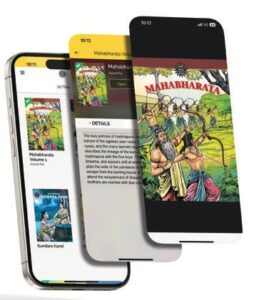 “Today, we can safely say that the readership is split equally between the print and digital formats. Our apps get upgraded regularly for an improved reading experience. We’re available on Kindle and Magzter. Our content has been used on Vobble (an audio format) and we’re exploring new audio partners. We have dedicated YouTube channels where videos are regularly uploaded. We have a robust social media presence across platforms. During covid, data usage in India went through the roof. It went upto 24GB per user per month. App based consumption in rural areas overtook urban consumption. We became a video first country that preferred regional, snackable content. Our social media channels strategically cater to the changing preferences of adult consumers. We have also partnered with media houses like Applause and Junglee Films and animation studios Like Zebu Animation to bring our characters to OTT platforms and the big screen. The next big transformation is AI. As we explore how to integrate AI in our creative process, we also are mindful of upholding the integrity of our storytelling and art,” she shares.
“More recently, we conducted a digital Read-a-Thon where more than 100 schools from all over India participated, making this a one-of its kind to happen in recent times. It is always our endeavour to make our content relevant and interesting to readers. We do know that we cannot wish away the screen from a child’s hands, so our efforts are aimed at embracing the screen to further reading. The advantage of comics is that they can be enjoyed both for the story as well as the art. We also experiment with scrolling comics and other formats that are better suited to digital reading,” shares Gayathri.
On translations…
“As a kid, I loved reading books set in different countries. Whenever I travel, within India or abroad, I enjoy picking up books by local authors. Nothing can give you the feel for the land, people and culture like a local piece of writing. Thank God for translations, or we would never be able to experience anything in a language not known to us. This is of particular import in a multilingual country like India which has 22 official languages and hundreds of dialects. Translations act like vital bridges which allow stories to permeate across language and cultural barriers. A kid in Punjab should be able to enjoy a story from Kashmir. Translations democratize storytelling for both the writer and the reader. Anyone can tell a story in any language, and it can be made available to readers all over the world. They also preserve and amplify local voices. When there is a possibility of reaching a bigger audience through translations, it makes business sense to keep the stories coming. They help to bring marginalized voices and viewpoints to the mainstream. When we read about viewpoints that are new and different to our experience of life, it makes us open-minded, curious and more accepting of others. When a plethora of regional Indian narratives reach an international audience, it fosters an authentic and nuanced view of India and Indian literature. Another curious effect of translations is that they enrich the language they are translated into. The manner in which words and phrases are used to convey the soul of the parent language, shows us how language can be stretched and moulded, Amar Chitra Kathas have been translated in 36 languages and counting. Our latest translation was in Azerbaijani.” shares Gayathri.
What next?
“Amar Chitra Katha, founded in 1967, has been India’s Favourite Storyteller for close to six decades, and we will continue to do what we do best. We’re releasing two highly anticipated books, The Gita and Dashavatar this year under the Amar Chitra Katha imprint. Tinkle released its 830th issue this November. We’re celebrating our 45th anniversary, with a bumper issue with many special stories and features,” concludes Gayathri.
Comments are closed.