
Tamil diaspora BookMarket offers a SEA Change!
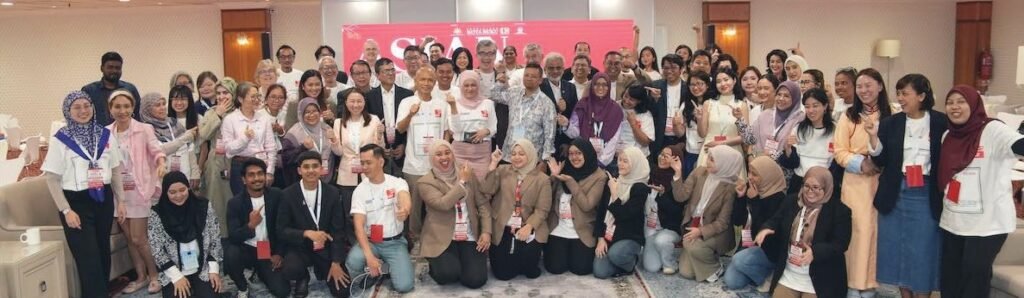 Exploring a long-overdue frontier, Tamil publishers are now turning their gaze eastward—towards the vibrant and culturally rooted Tamil diaspora of Southeast Asia. With the first Tamil Book Fair held in Singapore and growing interest from regional publishers and writers, a new chapter in cross-border literary collaboration has begun. This isn’t just about selling books—it’s about rekindling centuries-old connections, reviving cultural exchanges, and building a truly global Tamil publishing ecosystem. Karthikeyan Pugalendi shares more.
Whenever we go to the Sharjah book fair, our fellow Malayalam Publishers always ask us why we haven’t explored the Singapore Malaysia market. We couldn’t enough say how we wished for it. So when an opportunity knocked our doors, we thought it was worth the gamble.
Amidst the heated political and language debates, we were on a quest of our own, trying to explore the Tamil diaspora in Southeast Asia (SEA). In terms of population, Tamils are more or less the same in numbers when we compare the Middle East countries to the South East. However, we could feel that the Malayalam and Hindi-speaking populations fared better because of their rich cultural connections in the Gulf.
 Language diaspora…
Interestingly when we speak about any language diaspora, there are 3 different categories: Overseas Indians, Non-Residential Indians, and People of Indian Origin. As one of the earliest sea-faring communities Tamil king Rajendra Chola was the first to record a victory over Sri Vijaya and our naval expeditions flourished ever since. So, besides participating in the book fair, we planned our trip in such a way we visited important museums, libraries, and excavation sites wherever we went in Singapore and Malaysia.
Literary festivals in Singapore…
Singapore Tamils have a strong literary festival since the writers association is very active. We are thankful for the efforts put in by the President, Andiappan and aptly supported by his team Anbu Chelvan, Prema Mahalingam and Pandian and many others. In the South East, most of the publishers of Tamil origin are based in Malaysia. They don’t deal with Tamil books alone. They also publish heavily in Malay, English, and other SEA languages. It was interesting to note that most of them have become a media house extending their digital presence with Tiktok and Insta, printing mostly educational supplements and sourcing books for general reading from Tamilnadu, and are looking at avenues to co-publish.
This was one of the major reasons why Singapore writers wanted to invite Tamil publishers from Tamil Nadu (TN) and open up a dialogue. Tamil writers based in Srilanka, Canada have a sizeable readership in TN. We exchanged ideas on how we could make the association mutually benificial. There was a fierce debate on how the editorial inputs given by a publishing house in TN will help the diaspora Tamil writer. In a way I thought publishing industry back in India is also at the cusp of transforming from a print intensive knowledge industry into a digitally enabled entertainment and education industry.
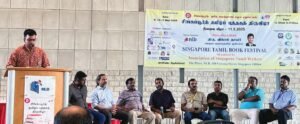
Tamil is one of the official languages in Singapore; an entire month is celebrated as the Tamil month in April. The first edition of this book fair organized by the Singapore Tamil Writers Association was a three-day event with an array of activities between May 9-11 in a way of celebrating the 60th year of independence. Five Tamil Publishers: Sixthsense Publications, Discovery Book Palace, Ethir Veliyeedu, and Yaavarum Pathippagam took part as exhibitors. The venue was the National Library on Victoria Street.
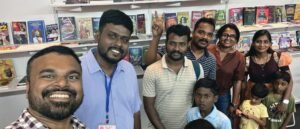
 It was courteous of the Singapore government to avail the space for a cultural event without any rent. Minister of Law, K. Shanmugam inaugurated the event and spent time at each bookstall purchasing books. The sale was good and children came in big numbers with the student token worth 10$. We have to give it to the STWA for making this event a grand success. In the future, we believe they’ll extend the number of days and try to accommodate the book fair in the Tamil month.
Even before it became Singapore, Temasek has documented its global importance as a supply chain hub for any kind of trade relations between China and the Middle East. Shipwrecks and their underwater excavation speak volumes. It was during the colonial era Tamils played a major part in their freedom struggle and the rest is history.
Book sales in SEA…
 Comparatively it is easier to sell a book in SEA beyond book fairs and take it to the retail stores than in the UAE because of the cultural connect. Media code licenses, getting our books catelogued in a way periodic metadata is published with libraries, instutions and stores is something we have started to learn from early movers like DC books and experts like Nielsen Book Scan. Since there is still a lot of clout about which is going to be the apex body for books in India : Capexil, NBT or FICCI we have also spoken to the Tamilnadu textbook society and CIBF to design a pilot program that makes access easier for publishers.
Overall as representatives of the Tamil publishing fraternity, we are very hopeful about building a global supply chain if we crack Singapore. Likewise, we have organizations that source books from us and run book fairs under various Tamil associations in the US, UK, Germany, Canada, and Srilanka. Having an international book fair calendar just like our local book fairs doesn’t seem like a distant dream anymore. POD facilities offered by the likes of Ingram and their Indian counterparts can be exploited when there are reorders and we can have editions exclusively for the diaspora market in the long run.
Other book fairs…
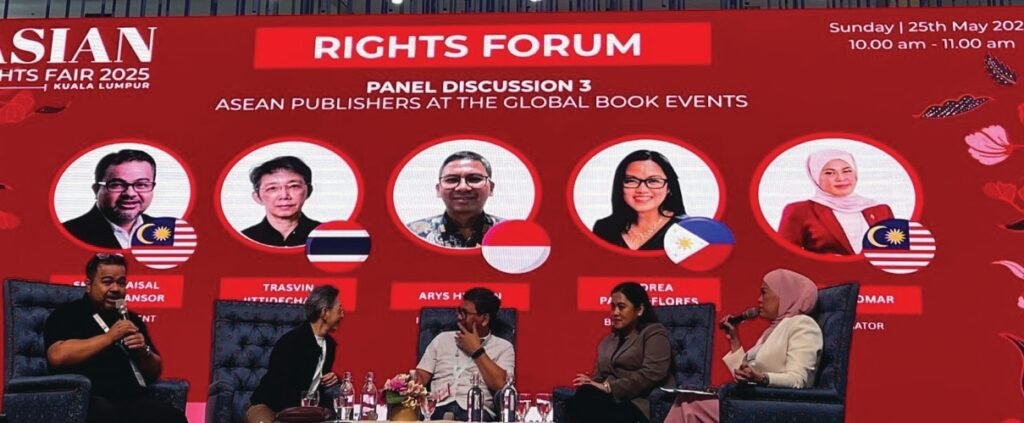
 I could only make a flying visit to the Asian Rights Fair organized by Kota Buku. Though this is just the first edition having participants from 24 countries, 120 publishers & agents with 468 business meetings seemed to be quite a show.
I was even more excited to visit the Malaysia Book Fair in Kaula Lumpur (KL) around the same time and in the same venue. But it was sad that there was no Tamil stall. Even the publishers of Tamil origin kept only activity-based books for kinds in their stalls. Hope we can plan our future participation in a way we take part in the KL book fair after the Singapore book fair with the support of the TN govt in the successive years!
Karthikeyan Pugalendi hails from a family of publishers with a legacy of more than 75 years in the trade he has had the privilege of meeting eminent personalities from all disciplines and hold close interactions with many. He writes columns both in Tamil and English about the publishing trends. He works with literary agents,technology providers, retailers, students and diasporaTamil worldwide to take Tamil globally and make Tamil content digitally adept.
Comments are closed.